


Occupational exoskeletons are gradually becoming a mainstream topic among industrial stakeholders. Nowadays, the automotive sector is taking the lead in the adoption of this technology, followed by the logistics and construction sectors. However, occupational exoskeletons are not yet showing their full potential. Current bottlenecks concerning legislation, standardization, and benchmarks are limiting the implementation of occupational exoskeletons at a much larger scale.
Exoskeletons are here to stay. With the support of new initiatives in legislation, standardization, and benchmarking, I foresee that exoskeletons will be broadly adopted by various industrial sectors. In the factory of the future, exoskeletons will be an intelligent and cooperative support tool to improve the quality of life of the industrial workforce. I believe exoskeletons will be eventually integrated into intelligent industrial clothing that will optimize and predict the impact of workload on workers’ health as well as overall operational performance related to product quality.
Wearable-driven analytics will go hand in hand with the exoskeleton technologies of the future, so platforms like WearHealth are important to speed up this transition. Exoskeletons and wearable-driven analytics have the potential to transform society by leveraging advances in artificial intelligence, blockchain, industry 4.0, digital twin, and 5G technologies. In my opinion, the biggest opportunity lies in developing transparent and ethical wearable-driven analytics from a data collection and a data analysis standpoint. This push towards transparency and ethics should be supported by efficient and effective algorithms that empower users with timely, accurate, and trustworthy results.
More Insights
December 5, 2025
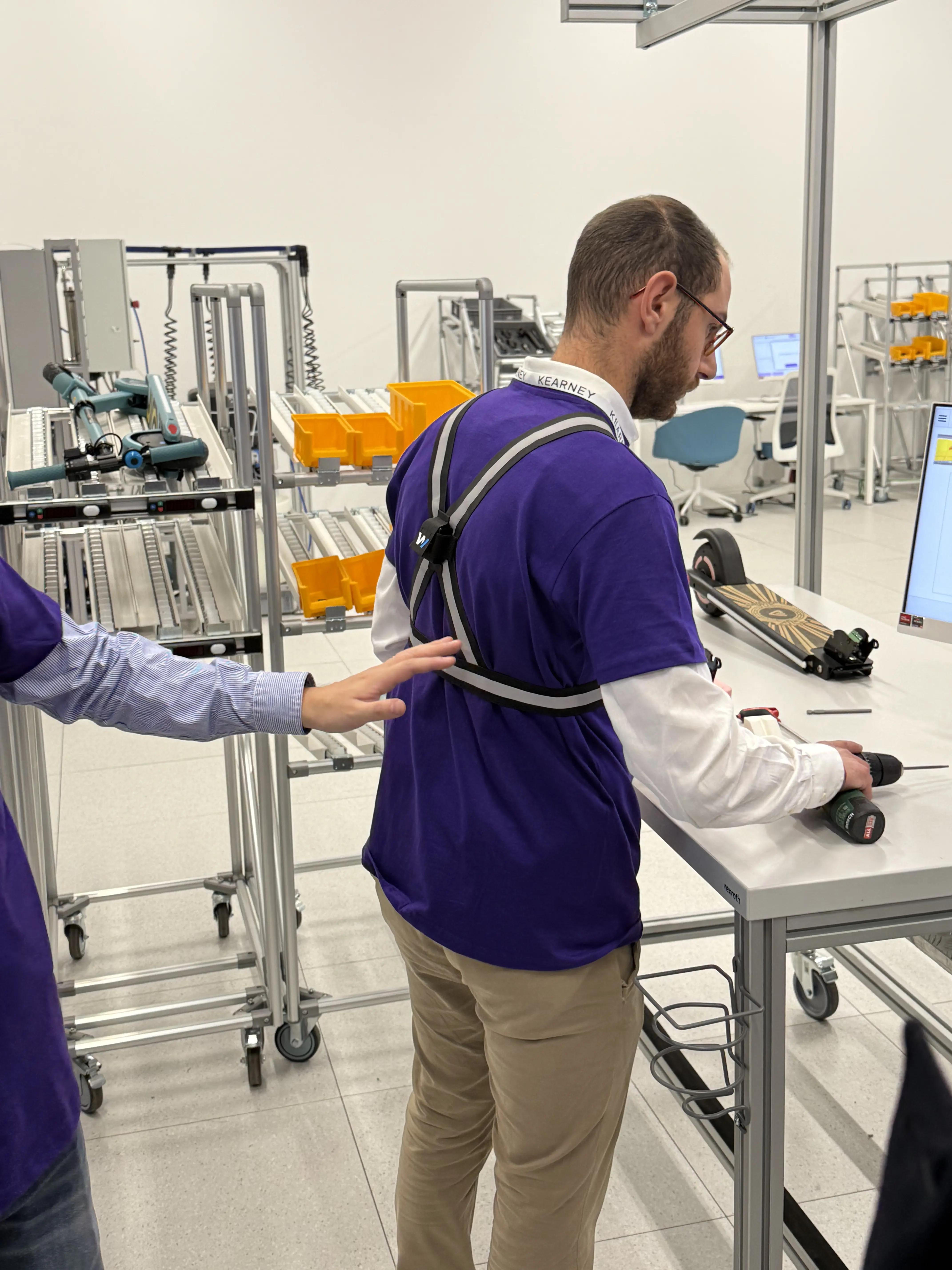
The newly launched Kearney Industrial Innovation Space (K-IIS) brings together cutting-edge technologies and real industrial use cases to help companies tackle operational challenges and WearHealth was part of it.
.jpg)
November 28, 2025
The EKAS conference at Migros in Switzerland showed how companies are approaching workplace health with a broader view — focusing on clearer insights and long-term workforce wellbeing.
